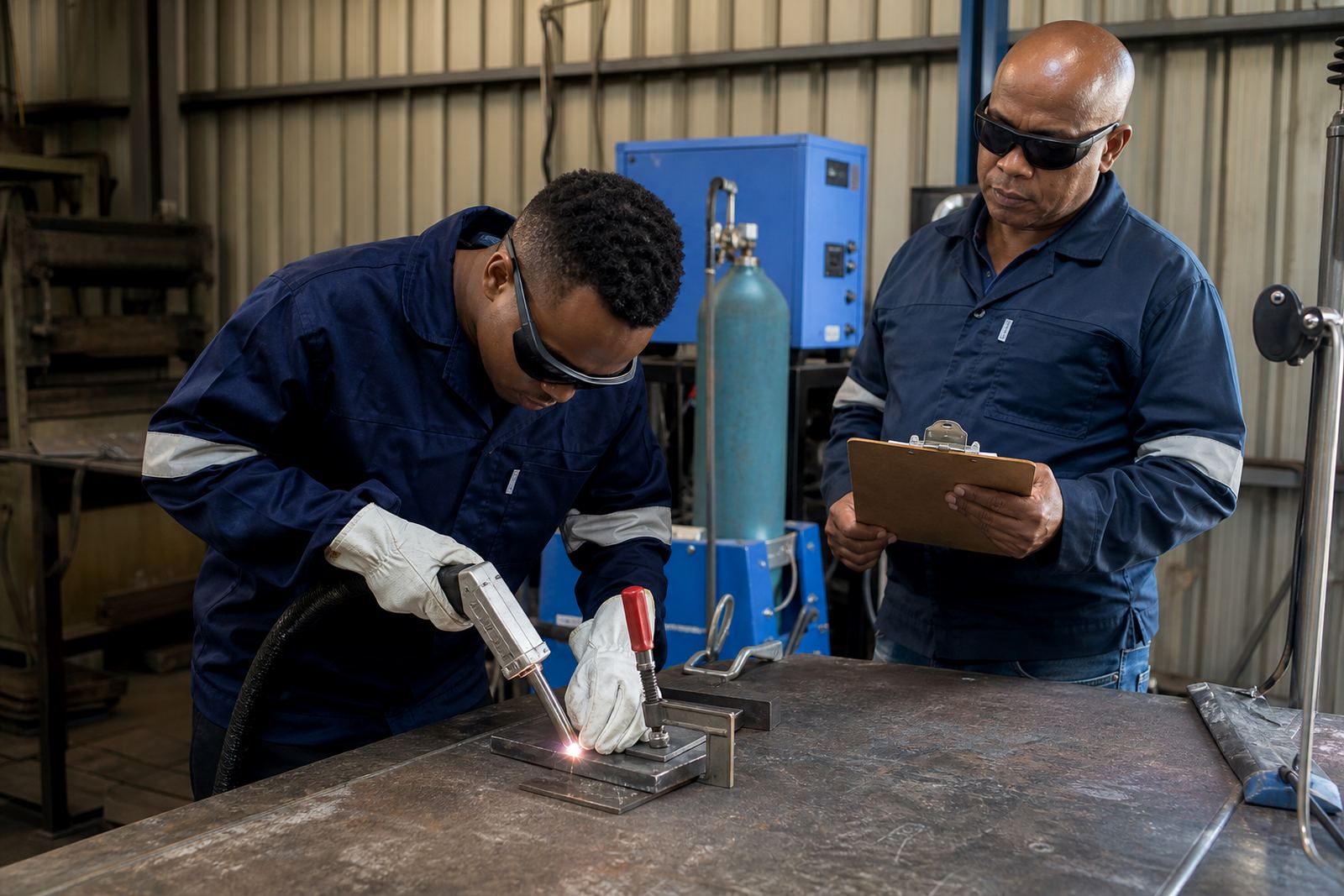
What a starter kit should help you do
A starter kit is not just a box of parts. In handheld laser welding, it should help the learner get through the first stages of setup, practise and basic production without missing key items. That means the kit should support the machine, the work area and the operator, especially when the work is being done in a small shop, a training room or a mixed-use workshop in Boksburg or on the East Rand.
For beginners, the main value is confidence. If a learner has the right protective gear, a clean work surface, sensible accessories and a clear routine, they can focus on torch handling, joint preparation and travel speed instead of borrowing parts or stopping every few minutes to improvise. For workshops, a starter kit can also reduce wasted time when a new operator joins the team.
A good kit should fit the type of work you plan to do. Thin sheet, repair work, brackets and light fabrication all need slightly different support items. The point is to begin with what is practical, then build from there as skill and workload grow.
Safety items that should never be left out
Laser welding safety starts before the trigger is pulled. A starter kit should support safe use of a laser system with the correct class controls, clear warning signs where needed and proper eye protection matched to the machine and the task. Learners should never rely on ordinary workshop glasses if the system calls for specialised protection.
Handheld laser welding also creates fumes and fine particles from the metal being processed. That means fume extraction is not optional if you want a cleaner work area and better breathing conditions. In Gauteng, where many workshops run with doors open during load-shedding or in hot weather, airflow alone is not enough. Extract at source where possible and keep the workspace tidy so fumes do not hang around the operator.
A starter kit should make safe habits easier to follow. If the gear is organised, labelled and stored close to the machine, the operator is less likely to skip steps when work gets busy.
- Laser rated eye protection for the task at hand
- Fume extraction suitable for the material being welded
- Clear operator boundaries around the work area
- Fire aware housekeeping, including removal of flammables
- Visible procedures for shutdown, cleaning and storage
The parts and tools that save time on day one
Most new learners do better when the starter kit includes the small things that are easy to overlook. A machine can be ready, but if the surface is not clean, the clamps are poor, or the wire and nozzles are not organised, the work slows down quickly. That is where practical starter kit planning pays off.
For an owner operated workshop, time matters. One missing consumable can hold up a job, especially when a customer wants a quick turnaround on a gate repair, a frame, a bracket or a small production run. In places like Pretoria, Durban and Cape Town, where workshops often balance repairs with new work, having the basics on hand keeps the day moving.
- Cleaning brushes, wipes and prep tools for metal surfaces
- Clamps, magnets or holding aids for positioning
- Spare consumables used in normal weekly work
- Marker tools for setting out joints and weld lines
- Storage containers for small parts and offcuts
The aim is not to buy everything at once. It is to avoid the false economy of starting with too little, then paying for delays later. A well chosen kit supports the machine and the operator from the first practice weld.
How starter kits support training and certification
When someone completes a course, they should leave with more than notes. They need repeatable habits, a safe sequence and the confidence to set up a small job on their own. That is why starter kits matter in training. They help learners practise the same routine again and again until it becomes natural.
At LaserWelder Training, courses are built around hands-on work and the certificate of completion issued by LaserWelder Training only. A starter kit fits into that process by supporting the practical side of learning. It helps learners work through joint prep, machine setup, sample welds and inspection without depending on borrowed tools or ad hoc solutions.
For businesses, the kit can also help when more than one person needs to use the equipment. A supervisor can keep a standard setup list, a basic consumables count and a simple routine for daily checks. That makes it easier to bring in new staff, run refresher visits and keep work consistent between shifts.
A practical Boksburg example
Consider a small workshop in Boksburg taking on a mix of repair work and light fabrication. The owner wants one learner to start using handheld laser welding for neat, controlled joints on thinner material. The machine is ready, but the workshop has limited space, some jobs come in after hours, and power interruptions can affect the day. In that setting, a starter kit does a lot of quiet work.
The kit should help with setup, storage, cleaning and safety, so the learner can get to the job quickly when power is available and shut down properly when it is not. It should also suit a busy local workshop where parts move between benches, material racks and the welding area. With the right accessories close at hand, the team spends less time hunting for items and more time producing usable welds.
That same logic applies in Johannesburg, Polokwane, Durban, Cape Town and Pretoria. The workshop might differ, but the need is the same: keep the first steps simple, keep the area safe and keep the operator supplied with the basics needed for steady progress.
Choosing a starter kit without overbuying
It is easy to overbuy when starting out. Many workshops think they need every accessory on day one, when in fact they need a careful base kit, then a sensible plan for adding items as use increases. The better question is not what is available, but what will actually be used in the next month.
Ask whether the kit helps with safety, setup, practice and day to day handling. If an item does not solve one of those problems, it can probably wait. That approach is especially useful for owner operators who need to manage cash flow and keep the workshop tidy. It also helps with training groups, where learners benefit more from clear routines than from too many extras.
If you are not sure what to include, speak to the team at LaserWelder Training through the enquiry form on the contact page. The right starter kit should match the learner, the machine and the type of work planned, not just fill a shelf.