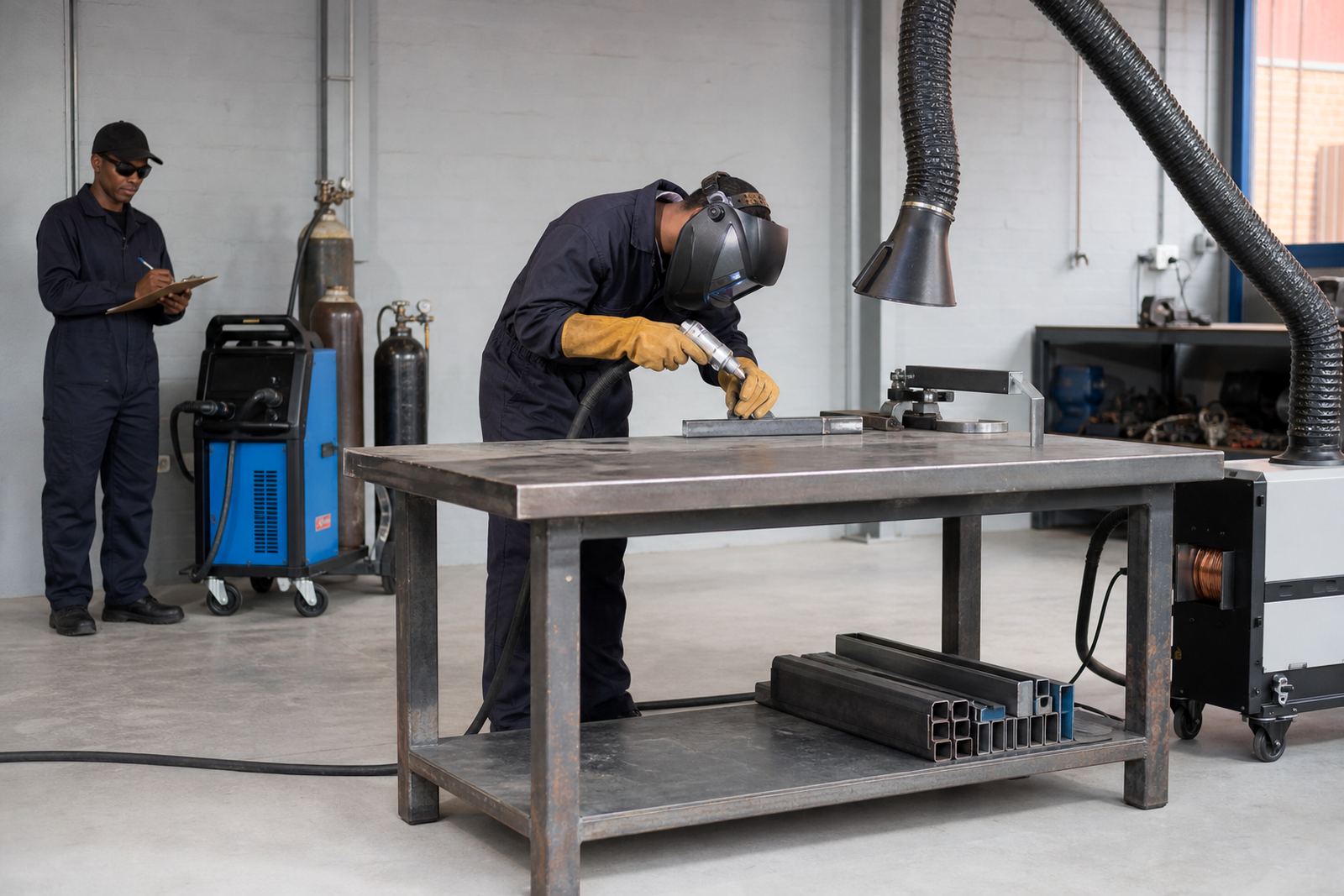
Why coupon shape matters in repeat laser welding practice
A practice coupon should answer one question at a time. If the piece is too large, the learner spends time handling offcuts instead of working on the weld. If it is too small, the torch angle changes too much and the results become hard to compare. For handheld laser welding, a coupon that sits flat on the bench and fits the clamp jaws properly is usually the best starting point.
Most teams do better with coupons that let them repeat the same weld path, then inspect bead shape, edge fusion and heat marking. That is useful for beginners and also for experienced operators who want a quick refresher before a job. In practice, the coupon should reflect the material thickness and joint style used in the workshop, not just look neat on paper.
Straight strip coupons for butt joints and edge control
Straight strip coupons are the easiest way to train on butt joints. Two flat strips, cut square and cleaned properly, let the learner practise alignment, gap control and travel speed. A good size is usually long enough to allow a few passes, with enough width for clamping and a safe hand position. In Boksburg, where many workshops deal with small fabrication repairs, these coupons are handy for sheet and light plate work.
For repeat sessions, label each strip with the material type and thickness. That makes it easier to track improvement over time and helps the instructor match the right power, wire feed if used, and speed. A simple strip coupon also works well for joint prep checks, because small burrs, oil or rust show up quickly in the weld result.
- Use two strips of the same thickness for a clean butt joint test
- Leave enough length for at least three practice runs
- Mark the coupon before welding so results can be compared later
- Keep edges clean and square for fair testing
Corner and lap layouts for the joints learners meet most often
Corner and lap coupons are useful because many beginners struggle with torch angle near the overlap. A right angle coupon shows how well the learner manages heat on both sides of the joint, while a lap coupon shows whether the top sheet is fusing without burning through the lower one. These are practical shapes for workshops that repair guards, brackets, small frames and panels.
When you set up these coupons, keep the overlap width the same from piece to piece. That gives the learner a fair repeat test and makes the training document pack more useful later. If the work area has load-shedding or limited bench space, smaller coupons can still work well as long as the clamping is stable and the joint is visible from all sides.
- Corner coupons help with angle control and edge melt
- Lap coupons show how heat moves across the overlap
- Use the same overlap distance on every sample
- Clamp firmly so movement does not affect the weld line
Hole, patch and repair coupons for practical fault-finding
Not every training exercise should be a perfect joint. Hole repair and patch coupons are helpful when a workshop wants to test control on damaged material, thin sections or awkward shapes. These coupons can be cut with one opening, a notch or a patch area that the learner must fill and blend. They are ideal for experienced staff who need to handle real repair jobs rather than only fresh clean stock.
A patch coupon also teaches fit-up. If the patch is too tight, the learner learns nothing about heat control. If it is too loose, the gap will distort the result. The goal is to create a repeatable test that reflects common repair work without turning the session into scrap chasing. Keep the shapes simple and easy to inspect after each pass.
Marker layouts that make a coupon useful after the weld
The best coupon is one that still tells a story after the torch is put down. Clear marker layouts help instructors and supervisors compare each attempt. Mark the material, thickness, joint type, date and operator initials on the edge before welding. It saves time during the review and stops samples getting mixed up in busy training rooms.
For repeat sessions, some shops use a simple grid or numbered zones on the coupon. That lets the learner target one section at a time and compare the bead from one area to the next. It also helps when you are planning refresher visits, because the same layout can be used again and again for the same team.
- Write the material type and thickness on every coupon
- Use zone marks to separate test areas
- Keep one layout for beginners and one for supervisors
- Store completed samples flat and dry for future review
Safety items to build into every practice coupon session
Handheld laser welding needs proper safety controls every time, even on small coupons. The laser class must be treated seriously and eye protection should match the equipment and process in use. Learners also need fume extraction positioned close to the work area, especially when welding coated material, zinc plated parts or stainless steel in a closed workshop.
A good practice coupon session should include a short safety briefing before the first weld. That briefing can cover beam awareness, reflective surfaces, keeping hands out of the line of travel and checking that the extraction unit is running. In coastal areas, humidity can affect stored coupons and consumables, so dry storage matters too. If the workshop has limited power during load-shedding, plan the session so the safety gear and extraction are ready before training starts.
- Use eye protection rated for the laser process in use
- Set fume extraction close to the weld point
- Keep reflective scrap and polished offcuts away from the bench
- Store coupons and starter kit items in a dry place
A local example from a Boksburg training day
A practical coupon plan for a Boksburg workshop might include one butt joint strip, one lap joint pair and one small repair patch. That mix gives the team a useful view of alignment, overlap control and repair work in a single session. It also suits businesses that want to train staff from Johannesburg, Pretoria or the East Rand without changing the whole setup each time.
At LaserWelder Training, our hands-on sessions focus on repeatable practice, starter kit setup and clear supervision so learners can build good habits from the start. The point is not to chase fancy shapes. It is to make a coupon that matches the job, supports safe welding and leaves the operator with a cleaner result each time. When the coupon format stays consistent, the follow-up training becomes easier to plan and the supervisor can see exactly where the next improvement should go.