What Starter Kit Setup Covers
Starter kit setup is for learners, small workshops and maintenance teams that want a sensible starting point for handheld laser welding. We help you arrange the core kit items, place the right PPE where it is easy to reach, and set up storage so the tools are not left lying around on benches or in a corner of the shop.
The aim is simple: when a job comes in, the operator can get to the torch, wire, nozzles, cleaning items, protective gear and consumables without wasting time. We also look at the work area itself, including bench space, power access, cable routing, lighting and how the kit is returned after use. That matters in busy workshops, especially where load-shedding or shared work bays can disrupt the routine.
- Core kit layout for handheld laser welding use
- Storage for torch, cables, tools and consumables
- PPE placement for quick access before work starts
- Daily return points for neat, safe packing away
Kit Items We Help Arrange
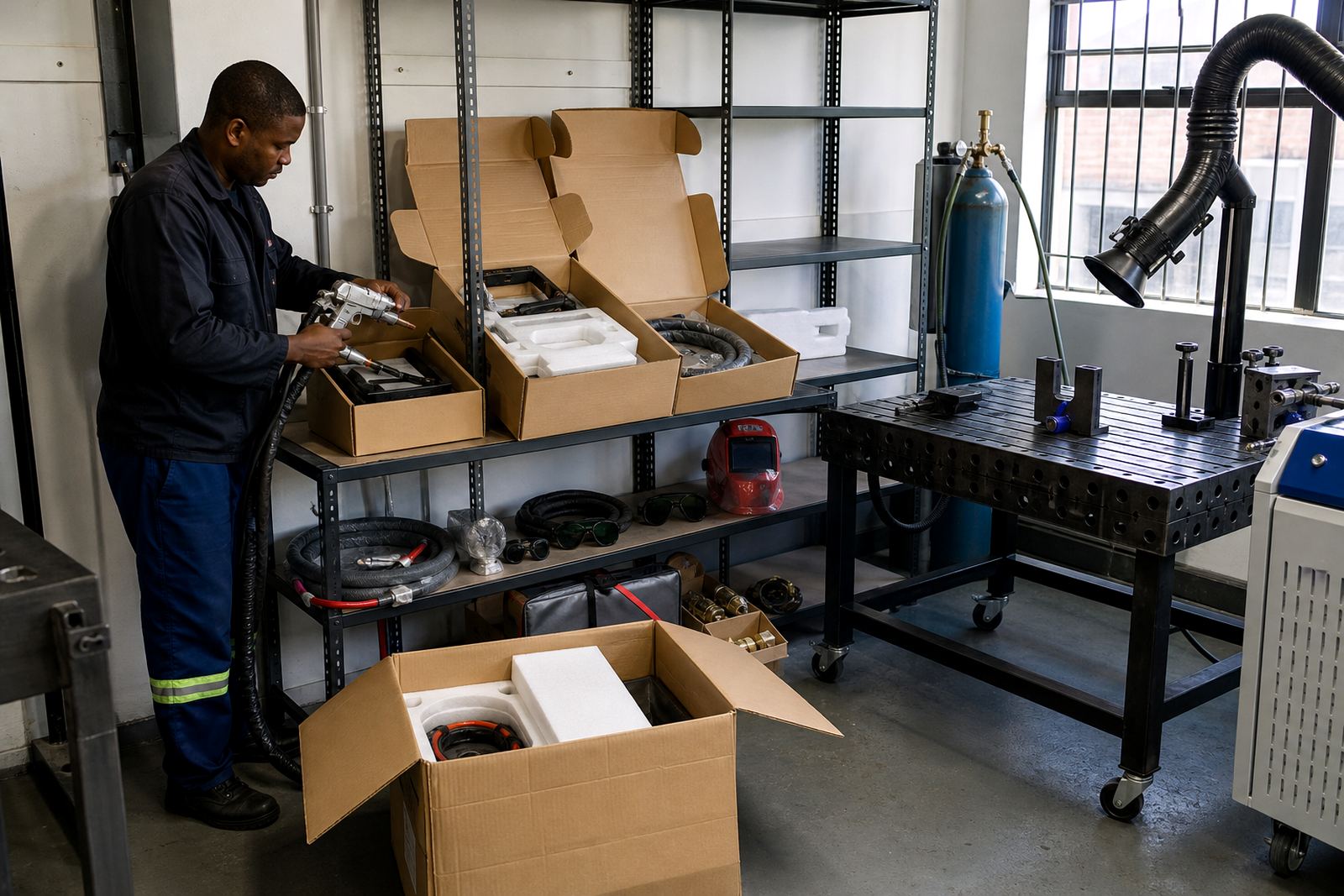
We work with generic handheld laser welding starter kit items that are commonly used for training and basic workshop use. That includes the welding unit itself, handpiece, fibre lead, cleaning tools, nozzle spares, wire feed accessories where applicable, and the basic protection items needed for safe operation.
We also check that the kit is suited to the space. For example, a small Boksburg workshop may need a compact trolley and wall storage, while a larger service bay in Johannesburg or Pretoria may need a fixed station with marked shelves. The setup can be adapted for shared use, but it must still stay orderly and easy to clean.
- Handheld laser welding unit and handpiece
- Protective eyewear rated for the laser class in use
- Fume extraction or local extraction positioning
- Cleaning brush, cloths and tip care items
- Wire, nozzles, spares and consumables container
Safety Placement And Access Control
Laser safety starts with where the kit is placed and how people move around it. We help position the machine, PPE and warning items so the operator can work without unnecessary exposure. The setup supports controlled access, clear storage, and a tidy route for cables and hoses so nobody trips during a shift. That is especially important in workshops with visitors, apprentices or more than one team sharing space.
We also include guidance on practical safety items that support handheld laser welding use. Depending on the laser class and the work being done, that may mean suitable eye protection, clearly marked PPE storage, and a fume extraction point close enough to catch smoke and fine particles before they spread. A clean work area is not only safer, it also makes the training easier to repeat day after day.
- Eye protection placed at the point of use
- Fume extraction kept close to the welding position
- Clear access to emergency stop and shut-down steps
- Marked storage for PPE and consumables
Our Setup Process In Plain Steps
We keep the process practical. First, we confirm what kit you already have and what the work area looks like. Then we map the storage and access points, check where the power and extraction will sit, and plan how the starter kit will be used in day-to-day work. After that, we do the actual setup and walk the team through the sequence.
The handover includes simple operating order, safe packing away, and how to keep the kit ready for the next operator. We can also advise on workflow, so the starter kit is not being moved around more than necessary. If your workshop supports different sites, we can help plan a setup that is easy to repeat at each location without confusion.
- Step 1: confirm the kit list and workspace
- Step 2: plan storage, safety and access points
- Step 3: install or position the kit and PPE
- Step 4: run through use, cleaning and shut-down
Turnaround For Boksburg And Other Areas
Turnaround depends on the size of the kit, the workshop layout and whether extraction or storage needs to be arranged at the same time. A simple setup can often be completed quickly once the items are on site, while a larger multi-user workshop may need a longer visit because there are more access points and more people to brief.
For clients in Boksburg, the East Rand and greater Gauteng, planning is usually straightforward. For Johannesburg, Pretoria, Durban, Cape Town and Polokwane, we plan the visit around the workshop schedule so the kit can be set up without disrupting production. If the site has limited power availability or shared work bays, we factor that in from the start rather than fixing problems later.
We can also arrange refresher visits if the kit is moved, expanded or used by new operators. That keeps the setup consistent and reduces mistakes when staff change.
Pricing Approach And Maintenance Intervals
Our pricing approach depends on the size of the kit, the level of setup needed and whether there are extra items such as storage, extraction positioning or operator briefing. We quote after checking the scope, because one workshop may need only a basic layout while another needs a fuller support plan with multiple stations. There is no need to pay for items you do not use.
Maintenance is part of keeping the starter kit ready. We normally suggest routine checks on a weekly and monthly basis, with a more detailed review after heavy use or after any move to a new bay. On coastal sites, stored items may need extra attention because humidity can affect cleaning cloths, metal parts and general condition. In busy Gauteng workshops, dust and repeated handling are the main issues.
- Weekly check: PPE, cables, cleaning items and storage order
- Monthly check: extraction position, consumables and handpiece condition
- After any move: repeat the setup and safety briefing
Key facts
| Service area | Boksburg, Gauteng and South Africa-wide |
|---|---|
| Kit focus | Handheld laser welding starter kit setup |
| Safety elements | Laser class awareness, eye protection, fume extraction |
| Typical use | Learner workshops, small teams, maintenance bays |
| Site types | Single station, shared workshop, multi-user setup |
| Output | Certificate of completion from LaserWelder Training |