

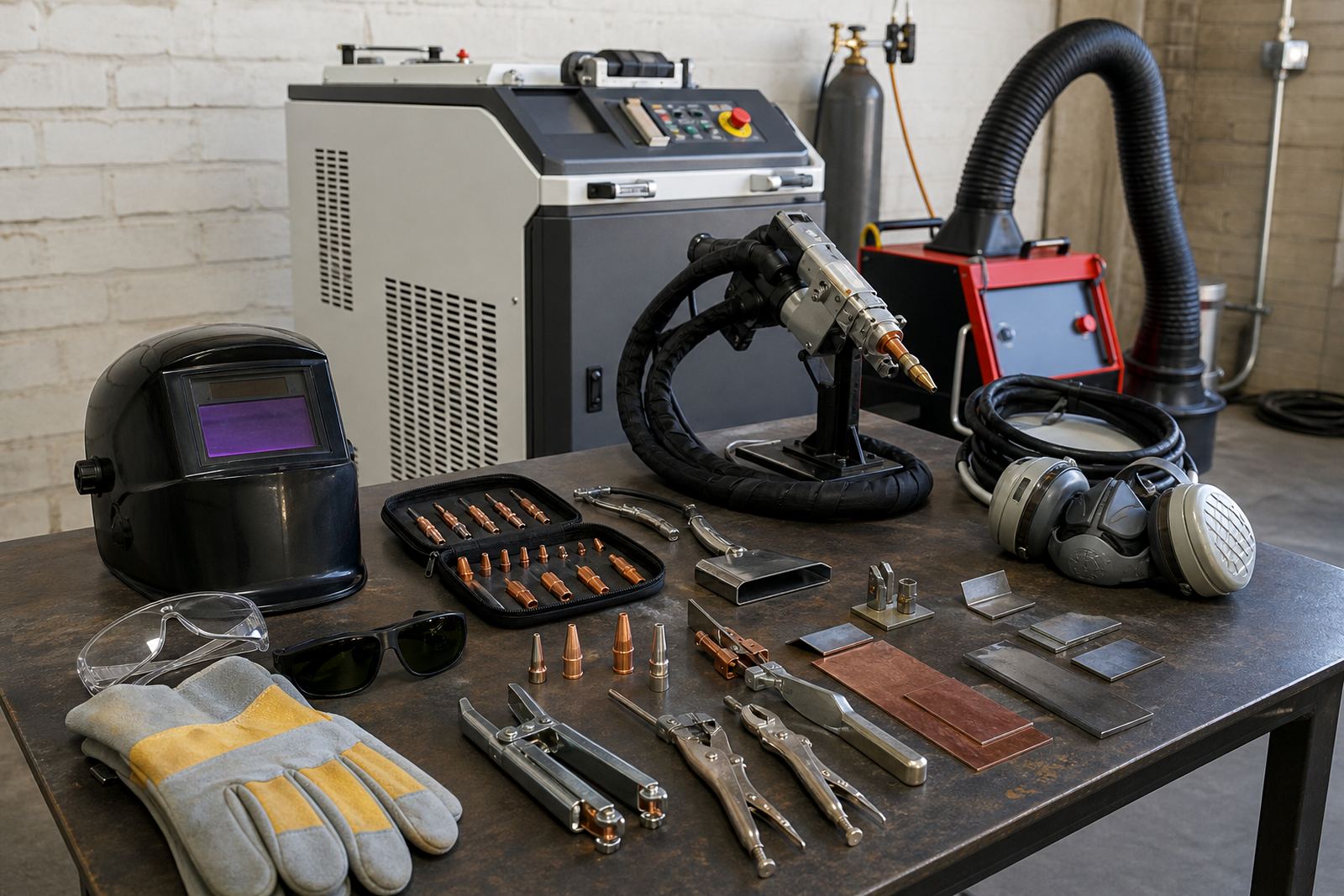
What the Workshop Starter Kit includes
This starter kit is built around the basics a working shop needs for handheld laser welding on light fabrication, repair work and learner practice. The package focuses on control, safety and repeatable setup rather than extras you may never use. It is suited to mild steel, stainless steel and aluminium work where a neat weld, steady hand control and tidy prep matter more than heavy production speed.
The kit typically includes the handheld welding unit, a torch assembly, a wire feeder where required, a work clamp, a set of contact parts, cleaning tools, protective eyewear, a simple starter pack of nozzles and lenses, and a basic fume extraction arrangement. Some workshops also ask for a trolley, spare consumables and a set of practice coupons so the first week is not spent chasing small missing items. That saves time when the workshop is already busy.
- Handheld laser welding unit with torch assembly
- Safety glasses rated for the laser class supplied
- Fume extraction kit for indoor use
- Basic cleaning and maintenance tools
- Starter consumables for practice and setup
- Optional trolley and storage set
Sizes and options for different workshops
Not every workshop needs the same setup. A small repair bay in Boksburg will not work the same way as a fabrication shop in Durban with more humidity, more staff movement and tighter day-to-day scheduling. That is why the kit can be ordered in a compact form for one operator, or in a fuller workshop set for a team that trains new staff and runs regular jobs.
For smaller spaces, a compact kit is easier to move and store. For busier sites, a more complete package helps with uptime because you have spares close at hand. If your team does both production and learner training, it makes sense to include extra eyewear, extra nozzle parts, more cleaning supplies and a clearer storage plan. Two kits are often better than one overloaded set that gets shared too much.
- Compact kit for a single work bay
- Expanded kit for two to four operators
- Training-friendly kit with extra practice consumables
- Workshop set with trolley and storage extras
The right option depends on what your team welds, how often the machine runs, and whether the site is training staff or only doing repair work. If you are on the East Rand and dealing with dust or open doors all day, a more complete cleaning and extraction plan is usually worth it.
Where it suits best
This kit suits small workshops that want a more complete support set for daily use without overcomplicating the floor. It works well for metal repair shops, fabrication bays, maintenance teams, engineering learners, and businesses that need a practical entry point into handheld laser welding. It is also a good fit where the operator must move between jobs, benches and fixtures through the day.
Because handheld laser welding is fast and very focused, the setup needs to be tidy. The work area should have enough clear space for the operator, the extraction hose, the power feed and the part being welded. On coastal sites, especially in Durban or Cape Town, it helps to keep consumables dry and sealed because humidity can affect storage and handling. In Gauteng, load-shedding planning matters too, so your workflow should allow for shut-down and restart without losing parts or settings.
- Small fabrication shops
- Repair and maintenance workshops
- Training bays and learner practice areas
- Sites that need a compact, movable welding set
Installation, power and gas requirements
The kit is meant for practical installation in a workshop, not a complicated production line. In most cases you need a stable power supply, a clean working surface, enough ventilation, and a safe place for the gas bottle if shielding gas is used. The exact power requirement depends on the unit selected, but workshops should allow for a dedicated circuit, proper earthing and enough headroom for safe start-up. If your site already struggles with trips or unstable supply, that must be checked before the kit is ordered.
Handheld laser welding normally needs a controlled work area with eye protection and a fume extraction unit close to the weld point. The extraction should pull fumes away from the operator, especially when welding coated material or working inside a smaller bay. If you are using shielding gas, store bottles upright and secure them properly. Keep hoses checked, regulators in good condition, and the floor clear so nobody catches a line during a busy shift. A little prep here avoids costly downtime later.
- Dedicated electrical supply with correct protection
- Safe earthing and cable routing
- Local fume extraction near the weld point
- Secure gas storage if shielding gas is used
- Clear floor space around the welding bay
Safety basics your team must check
Handheld laser welding is precise, but it still needs strict safety control. The laser class supplied must match the way the equipment is used, and the operator should wear suitable eye protection every time. Face protection and side coverage matter, because reflected light can still cause harm in a busy shop. The machine should only be used by trained staff who understand the controls, the shut-down steps and the safe distance around the work area.
Fume extraction is not optional in a closed workshop. Even on short jobs, fumes and fine particles build up quickly if there is no extraction. If you are working on painted, plated or dirty material, the air control becomes even more important. Keep flammable items away from the bench, make sure the fire extinguisher is in date, and brief every new operator before they touch the torch. A short talk before the first job is cheaper than a mistake later.
- Use the correct laser-rated eye protection
- Keep extraction running during welding
- Brief operators before first use
- Keep the bench clear of flammables
- Store the kit where access is controlled
Care, servicing and what to check when ordering
Good care keeps the kit useful for longer. Wipe down the torch and work area after use, check lenses and nozzles for wear, and keep the machine covered when not in service. Consumables should be counted before a busy week starts so you are not left short on a Friday afternoon. If the workshop is near the coast, store the kit in a dry room and inspect connectors more often because salt air can shorten service life.
When ordering, check the size of the work bay, the power available, the type of material you weld, and whether your team needs extra practice parts. Also confirm what comes with the kit and what is added later, because workshops often assume cables, clamps or extraction parts are included when they are not. Make sure the setup plan suits the site and the operator flow. If you are ordering for more than one branch, it helps to list each location clearly so the right package is matched to the right bay.
- Confirm the laser class and included safety gear
- Check power supply and earthing on site
- Ask what consumables are supplied in the box
- Confirm extraction and gas setup requirements
- List the workshop size and operator count
Support for workshops across South Africa
LaserWelder Training supports learners and workshops from Boksburg, Johannesburg, Pretoria, Durban, Cape Town and Polokwane. We also assist East Rand and Gauteng sites that need practical help with setup, operator induction, safety briefings, workflow advice, starter kit setup, practice plans and refresher visits. If your team needs guidance before the first shift, or a technical check after the kit arrives, that support can be arranged through the enquiry form on our contact page.
The aim is simple: put a workable starter kit in front of a team that needs to start safely and use it properly. Whether the site is a small repair workshop or a larger training room, the right setup makes day-to-day work easier and keeps the learning pace steady. For businesses that want a certificate of completion from LaserWelder Training for their learners, the kit can be paired with hands-on instruction and a clear document pack. That gives the workshop a proper base to build from, not just a box of parts.