Why stainless shows up every small mistake
When learners move from mild steel to stainless, they usually notice the difference straight away. Stainless reflects more light, holds a cleaner surface finish and shows heat marks, undercut and uneven bead shape more clearly. That is useful for training because it gives quick feedback, but it also means poor technique is obvious.
For visible seams, the aim is not only to join the metal. It is to keep the line straight, manage the heat input and leave a finish that looks intentional. On a gate frame, a handrail, or a small food-grade panel, a neat seam can save a lot of grinding and rework later.
Start with clean metal and consistent fit-up
Stainless must be clean before the torch ever touches it. Oil from hands, grinding dust, cutting fluid and sticker residue all affect the weld. Even a thin film can change how the molten pool behaves and can leave discolouration along the seam.
Learners should check the fit-up before they weld. Gaps that are too wide force the operator to chase the joint, while tight, even edges make travel smoother. On thin stainless, a bad fit can lead to distortion very quickly. If a part has been clamped unevenly, straighten it first rather than trying to correct it with the weld.
- Degrease the joint area before training runs
- Use clean clamps and a stable work surface
- Keep the edges aligned before striking the weld
- Practise on short coupons before moving to longer seams
Handheld laser welding on stainless needs a steady rhythm
Handheld laser welding is often chosen because it is quick to learn and can produce a neat seam with less heat spread than some other methods. That does not mean the operator can rush. A learner still needs a steady travel speed, a controlled torch angle and a clear path along the joint.
On stainless, it helps to work in short sections first. Keep the torch movement even and avoid stopping too long in one spot, because that can cause a wider heat affected zone and a patchy finish. If the seam begins to darken more than expected, slow down less and check whether the prep, power setting or shielding arrangement needs attention. In a Boksburg workshop, learners often notice that the same setting behaves differently on a thick plate compared to a thin tube, so each new job deserves a test piece.
- Keep your wrist relaxed and your elbow supported where possible
- Use test pieces with the same thickness as the actual job
- Watch the front edge of the pool, not only the glow behind it
- Stop and inspect often rather than running a full length first time
Visible seams need planning, not just neat hands
A visible seam is judged by more than straightness. The colour, width, edge blend and repeatability all matter. If the weld will remain exposed on a product, learners should think about finish before they start. That means choosing the right joint preparation, keeping the torch path consistent and planning any clean-up after cooling.
For stainless parts that will be seen by clients, supervisors often want less spatter, minimal heat tint and a smooth transition at the start and stop points. A learner who pauses too sharply at the end can leave a lump that needs extra finishing. A learner who starts too hard can leave a mark that stands out across the whole job. Good seam control is really about discipline.
- Mark the seam line clearly before welding
- Plan where starts and stops will land on the part
- Check the finish from more than one angle and in natural light
- Keep a sample piece for comparison during practice
Safety must be built in from day one
Handheld laser welding calls for proper eye protection matched to the laser class in use, together with a controlled work area. Learners should never assume ordinary workshop glasses are enough. The operator and anyone nearby need the right protection for the equipment and process being used.
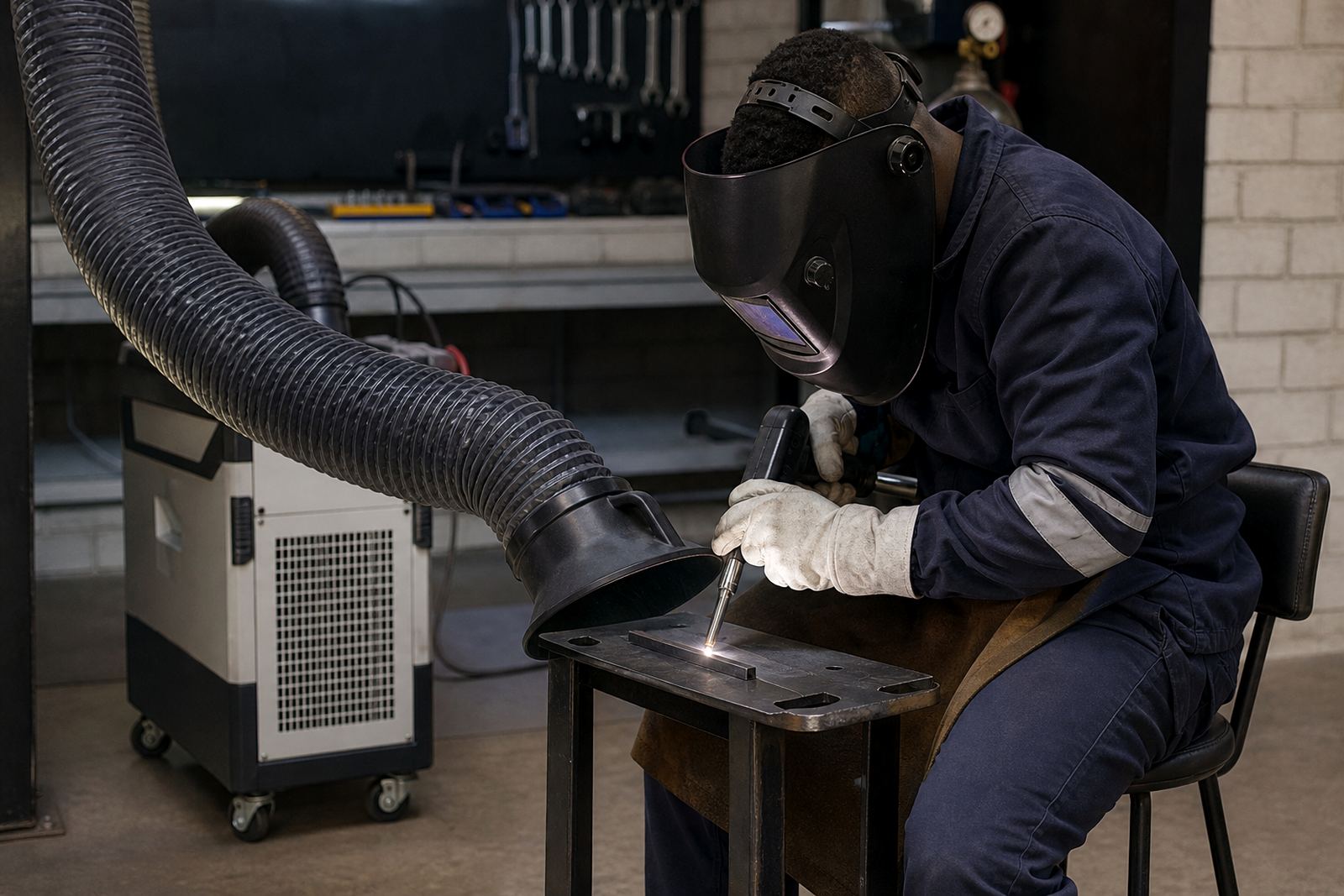
Fume extraction is just as important. Stainless can release fumes and fine particles during welding and grinding, so extraction should be placed close to the work point and maintained properly. In South African workshops, especially where doors stay open for heat or load-shedding changes the work routine, it is easy for people to relax their guard. That is when habits matter most. Keep cables tidy, know where the emergency stop is, and brief every learner before the torch is switched on. A short safety talk can prevent a long shutdown.
- Confirm the laser class and required eye protection before work starts
- Use fume extraction close to the weld zone
- Keep reflective surfaces controlled around the bay
- Do a safety briefing before every practical session
What should be in a starter kit for stainless practice
A good starter kit should help a learner practise safely and repeat the basics with confidence. For stainless work, the kit should support cleaning, alignment, protection and simple inspection. It does not need to be complicated, but it should be practical enough for daily use in a small workshop or training room.
Typical items may include protective eyewear suited to the process, cleaning tools, clamps, marking tools, sample coupons, basic inspection aids and guidance for setup. In some cases, learners also need support with workstation layout and where the extraction unit should sit. If the kit is to be used in a busy shop, it should be easy to store and quick to set up after a power interruption or a shift change.
At LaserWelder Training, starter kit setup and workflow advice are part of the support learners often ask for, because the first few practice weeks set the tone for later work. Once a learner knows how to organise the bench, clean the part and check the seam properly, training becomes much more productive.
A local practice example that makes the lesson stick
A common example in Gauteng is a learner practising on a stainless handrail section for a small commercial entrance. The job looks simple, but the visible seam runs along a place where every ripple shows. If the rail is slightly out of line, the weld line will show it. If the clamp pressure is uneven, the finish will show it. If the operator changes travel speed halfway through, the seam will show it.
That is why our hands-on courses place so much emphasis on short, repeatable practice runs. Learners are taught to inspect, reset and repeat until the seam stays consistent. Whether the work is for Johannesburg, Pretoria, Durban, Cape Town or Polokwane, the same rule applies: stainless rewards care. The more disciplined the setup, the better the finish and the less time spent on correction afterwards.
For businesses, this approach also helps when training new staff. A clear certificate of completion from LaserWelder Training shows the learner has taken part in structured practical training, but the real value is the working method they take back to the shop floor.