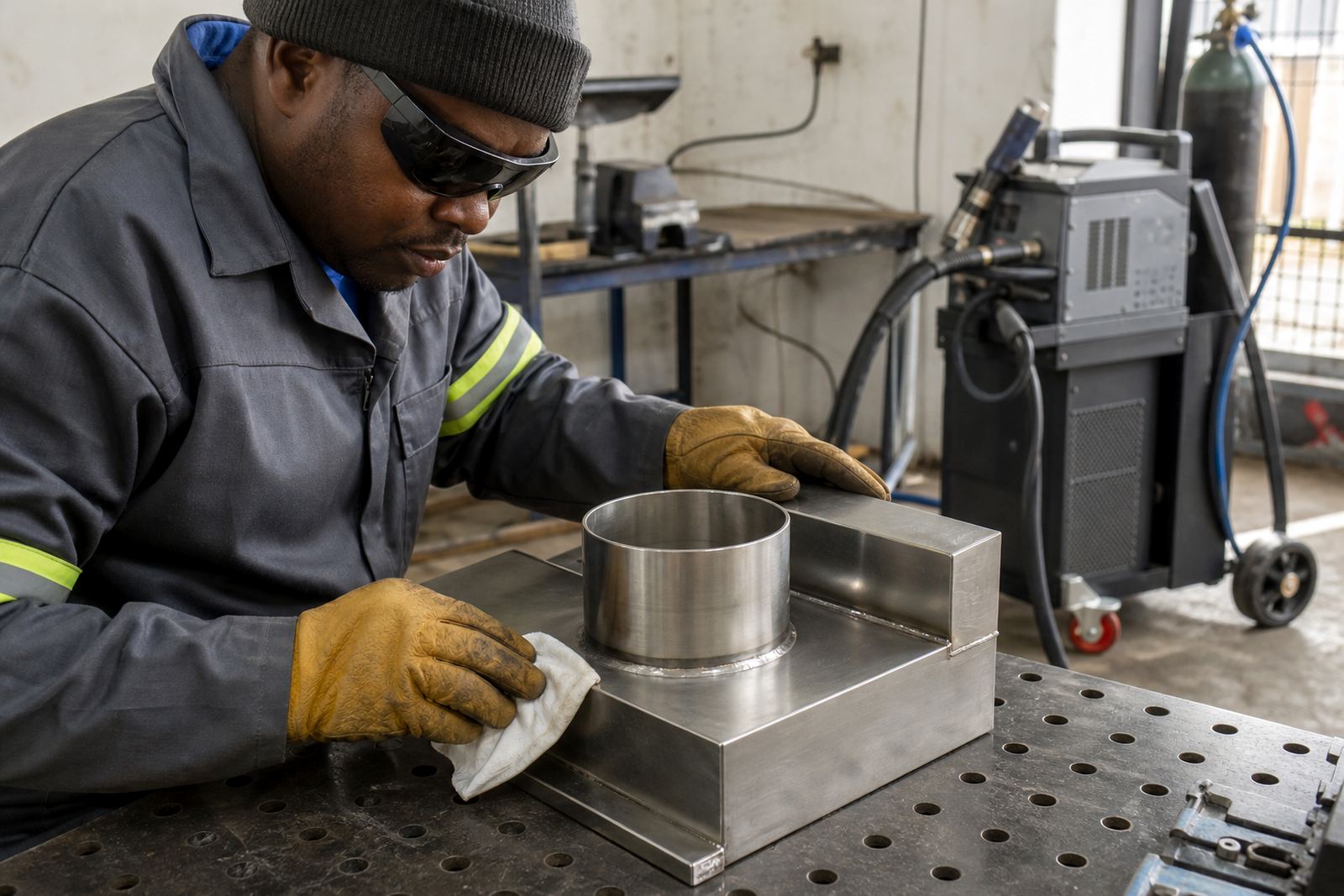
Centurion Brief and Workshop Reality
The client was a small manufacturing team in Centurion running light fabrication and repair work where different operators handled different jobs each week. Their main need was simple: get everyone working from the same process, with the same safety rules and a clear standard for handheld laser welding on day-to-day work.
The workshop had limited floor space, mixed shift cover, and the usual pressure of keeping production moving while training happens around the tools. We planned the visit around that reality, with enough time for hands-on practice but not so much disruption that the team lost a full day of output. The brief was to keep it practical, local and usable straight away.
- Client type: small factory team
- Town: Centurion, Gauteng
- Training format: on-site hands-on session
- Main focus: operator basics and safety alignment
What the Team Needed to Fix
The factory wanted a training session that did not stop at theory. They needed operators to understand when handheld laser welding is suitable, how to set up the work area, and how to avoid common mistakes with focus, fit-up and movement speed. They also wanted supervisors to know what to check before work starts and how to spot unsafe habits early.
There was also a safety concern around classification, eye protection, and fumes. Laser work is not a task where you guess your way through it. The team needed clear guidance on laser class awareness, correct protective eyewear, controlled access to the work zone, and extraction where fumes could build up. In a small factory, that stuff gets missed easily when everyone is rushing.
- Operator basics for new and mixed-skill staff
- Laser class awareness and controlled work zones
- Eye protection matched to the task
- Fume extraction and ventilation checks
What We Supplied On Site
We supplied hands-on training, a safety briefing, workflow advice and a starter kit setup session so the team could run the equipment with a clearer routine. The session also covered practical consumables planning, because a workshop can stall quickly if tips, shielding consumables or cleaning items are not ordered in time. That part is often overlooked until the first busy week hits.
We worked with the team on starter kit contents in general terms rather than pushing unnecessary extras. The aim was to set up a practical package that suited a small factory, not a showroom. We also included a training document pack and a refresher plan so the supervisor had something to refer back to after the session. One or two of the operators were nervous at the start, but once they saw the process step by step they settled in well.
- Starter kit setup guidance
- Training document pack
- Consumables planning support
- Refresher visit planning
The Training Week and How It Ran
The project ran over two weeks from booking to final handover. In week one we reviewed the site layout, the power supply situation, bench spacing, extraction points and the work sequence the team was already using. That gave us a good picture of what would work in the space and what needed changing before live practice.
Week two was the training visit itself. We started with a safety briefing, then moved into operator induction, then live practice on prepared material. The team worked through setup, torch handling, seam control, cleaning between passes, and visual quality checks. Where needed, we slowed the pace down and repeated steps so each operator understood the process rather than just watching it once.
- Week 1: readiness review and planning
- Week 2: on-site training and practical sessions
- Focus areas: setup, handling, seam control and quality checks
- Outcome: team-aligned procedure for daily use
Safety, Compliance and Factory Conditions
Because this was a small factory with regular movement around the work area, we gave close attention to access control and eye safety. We explained laser class awareness in plain terms, the need for correct eye protection and why no one should work near the beam path without proper precautions. Fume extraction was checked against the type of material being processed, since even small jobs can create smoke and fine particles that should not hang around in a closed space.
We also discussed load-shedding planning, because a lot of Gauteng workshops have to work around interruptions. The team needed a simple restart routine, plus a way to confirm that extraction and lighting came back on safely before anyone resumed work. That kind of routine saves time and cuts down on avoidable mistakes.
- Laser class awareness explained for operators and supervisors
- Eye protection checked for the task
- Fume extraction and ventilation reviewed
- Restart routine discussed for power interruptions
Results for the Centurion Team
By the end of the visit, the factory had a clearer process for operator setup, safer work habits and a better understanding of what good handheld laser welding looks like in a small production space. Supervisors had a simple checklist for start-up, and the operators had more confidence with the sequence of work. The main result was consistency, which matters when several people share the same process.
The team left with a certificate of completion from LaserWelder Training for the participants who took part in the course. They also had a starter kit setup plan and a cleaner view of consumables planning going forward. If we were to do the same project again, we would keep the same structure: short site review first, then practical training, then a clear handover. That order works well and avoids confusion.
- Clearer start-up and shutdown routine
- Better operator confidence across the team
- Certificate of completion issued by LaserWelder Training
- Practical follow-up plan for the workshop
Key facts
| Project type | On-site laser welding training for a small factory team |
|---|---|
| Town | Centurion, Gauteng |
| Training duration | 2 weeks from site review to handover |
| Core topics | Handheld laser welding, safety, workflow advice, starter kit setup |
| Safety focus | Laser class awareness, eye protection, fume extraction |
| Output | Certificate of completion from LaserWelder Training |